
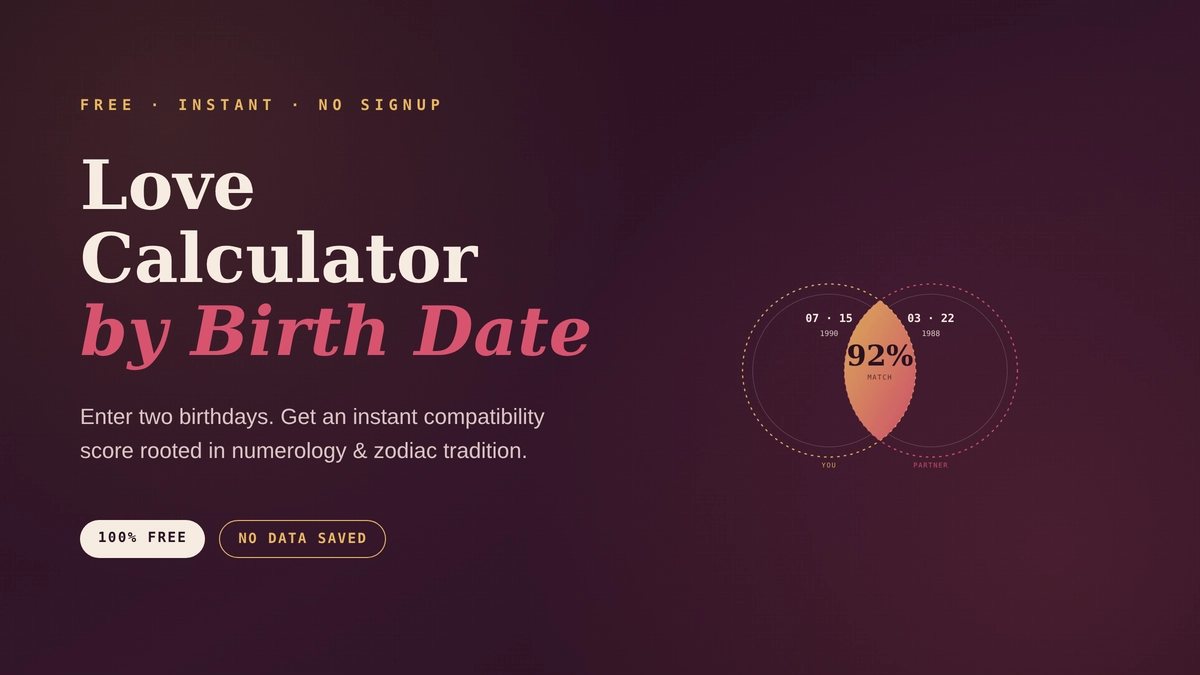
You type in two birthdays, hit calculate, and a number pops up telling you how “compatible” you and your partner are. It’s oddly addictive — even when you know, logically, that a website can’t measure chemistry with math. That’s the appeal of a love calculator by date of birth free: it’s free, it’s instant, and it turns something as personal as a relationship into a shareable little game.
This guide walks through exactly how these calculators work behind the scenes, whether the science holds up (spoiler: not really), and — more usefully — how to read your score without letting a random percentage mess with your head. By the end, you’ll know what that number is actually telling you, and just as importantly, what it isn’t.
Quick answer: A love calculator by date of birth uses numerology and zodiac-based formulas to generate a compatibility percentage. It’s a fun, free tool for entertainment — not a scientifically validated predictor of relationship success.
If you want to check your crush compatibility, visit this page.
What Is a Love Calculator by Date of Birth?
At its core, a love calculator by date of birth is an online tool that takes two people’s birthdays (sometimes their names too) and spits out a “love percentage.” The pitch is simple: your birth date supposedly encodes something about your personality, and comparing two people’s dates reveals how well those personalities mesh.
Under the hood, most of these tools borrow from two much older traditions — numerology and astrology — and repackage them into a quick web quiz. Worth saying upfront: neither of those systems has scientific backing. That doesn’t make the calculators pointless, though. Think of them less like a diagnostic tool and more like a horoscope for two — a fun mirror to look into together, not a verdict to live by.
How Does a Love Calculator Actually Work?
There’s no single industry-standard formula. Every site guards its algorithm a little, but most fall into one of three buckets.
Numerology and Life Path Numbers
This method reduces your entire birth date down to a single digit called a “life path number.” You add up every digit in the date until you land on one number (usually 1–9, with 11, 22, and 33 sometimes kept as “master numbers”).
For example: someone born July 15, 1990 would calculate it as 7+1+5+1+9+9+0 = 32, then 3+2 = 5. Their life path number is 5. The calculator then compares your life path number to your partner’s using a compatibility chart — some pairings are considered naturally harmonious, others more challenging.
Zodiac and Astrology Compatibility
Here, the tool figures out each person’s sun sign from their birthday and applies classic astrology rules — fire signs and air signs are said to get along, water and earth pair well, and so on. It’s the same logic behind horoscope compatibility columns, just automated.
Name-Based and Hybrid Algorithms
Some calculators throw names into the mix too, using letter-to-number conversions or the classic “LOVES” game format many of us tried in middle school. These are essentially just fun math tricks dressed up as insight.
The bottom line: whichever method a calculator uses, you’re not getting a scientifically derived answer — you’re getting a personalized, entertaining output based on centuries-old symbolic systems.
How to Use the Love Calculator: Step-by-Step
- Enter your birth date — month, day, and full year. The year matters for numerology math, so don’t skip it.
- Enter your partner’s birth date — order doesn’t affect the result.
- Click “Calculate” or “Check Compatibility.” The tool runs its formula instantly — no waiting, no account needed.
- Review your love score and breakdown. Most sites show a percentage plus a short label, like “Soulmates” (85–100%), “Strong Bond” (70–84%), or “Room to Grow” (below 50%).
Many calculators also let you screenshot or share the result — a nice touch if you’re doing this with friends or a partner as a lighthearted activity rather than a solo curiosity check.
Understanding Your Love Score: What Do the Percentages Mean?
| Score Range | Typical Label | What It’s Really Saying |
|---|---|---|
| 85–100% | Soulmates / Perfect Match | Strong alignment by the tool’s formula — fun to celebrate, not a guarantee |
| 70–84% | Strong Bond | Good numeric “harmony” — still just symbolic math |
| 50–69% | Moderate Match | A mixed result — most real couples land somewhere here |
| Below 50% | Needs Work | Low numerological/zodiac overlap — means nothing about your actual relationship |
Treat these bands as flavor text, not feedback. A relationship coach isn’t scoring you — an algorithm built for entertainment is.
Is a Love Calculator Accurate? Separating Fun From Fact
Let’s be direct: no, love calculators aren’t scientifically accurate, and no reputable psychologist or relationship researcher would say otherwise.
Both pillars these tools rest on — numerology and astrology — are widely classified as pseudoscience. Controlled studies testing whether astrologers can match birth charts to personalities have repeatedly found results no better than random chance. There’s no known mechanism by which the date you were born could influence how well you get along with another specific person.
That said, it’s worth understanding why these tools can still feel oddly accurate sometimes. Psychologists point to confirmation bias — we tend to remember the hits and forget the misses, and vague, flattering descriptions feel personal even when they’d apply to almost anyone (this is sometimes called the Barnum effect).
What actually predicts whether a relationship works, according to relationship researchers, are things no calculator can measure: how you communicate under stress, whether you share core values, how you repair after conflict, and the day-to-day effort both people put in. None of that shows up in a birth date.
Love Compatibility vs. Marriage Compatibility: What’s the Difference?
It’s worth separating these two, since calculators often blur them together.
- Love compatibility is about initial spark — attraction, chemistry, that early “we just click” feeling.
- Marriage compatibility is about staying power — shared financial habits, life goals, how you each handle conflict, whether you want kids, where you want to live.
A high love score from a calculator says nothing about the second category. You can have off-the-charts chemistry with someone who wants a completely different life than you do. If marriage or long-term commitment is actually on your mind, that conversation needs to happen directly with your partner — not through a percentage on a screen.
The Real Benefits of Using a Love Calculator
Despite the lack of scientific grounding, these tools aren’t without value:
- They’re free and instant. No signup, no paywall, no waiting — just a quick result.
- They spark conversation. A shared result gives couples or friends something playful to talk about, which, ironically, is one small ingredient of actual connection.
- They’re shareable. Clean, visual results are easy to post or send, which is part of why they stay popular year after year.
The Limitations You Should Keep in Mind
- They’re not predictive. No formula can forecast whether your relationship will last.
- They can create false confidence — or false worry. A high score might make you overlook real red flags; a low one might make you doubt something that’s actually going well.
- They oversimplify. Reducing a relationship to one number skips over everything that actually makes partnerships work or fail.
The healthiest way to use one: treat it the way you’d treat a horoscope — enjoy it, don’t build decisions around it.
How to Use Your Results Without Overthinking Them
- Use a high score as a fun moment, not proof. “We got 91%, that’s fun!” is a great way to end the conversation — not the start of over-relying on it.
- Don’t spiral over a low score. If the number’s underwhelming, use it as an icebreaker: “So what do you think it’s picking up on?” can lead to a genuinely useful conversation about your relationship.
- Try a couple of different calculators. You’ll likely get different results each time, which is itself a useful reminder that these numbers are symbolic, not measured.
- Redirect the energy toward real relationship-building. Communication, quality time, and consistent effort move the needle far more than any date-based formula ever could.
Final Thoughts: Love Calculator by Date of Birth – Free
A free love calculator by date of birth is exactly what it sounds like — a fun, zero-cost way to spend two minutes wondering “what if the universe really does line up birthdays.” It’s rooted in numerology and astrology, neither of which has scientific backing, and it shouldn’t carry weight in any real relationship decision. Enjoy the result, share it if you want, and then go invest in the things that actually build lasting compatibility: honest conversations, shared effort, and time spent together.
READ MORE: How to Calculate Love Compatibility with Zodiac Signs (Step-by-Step Guide)
Frequently Asked Questions
Is the love calculator by date of birth actually free?
Yes. Most versions online are completely free with no signup required, and you can test as many date combinations as you like.
How accurate is a love calculator?
Not scientifically accurate at all. These tools rely on numerology and zodiac formulas for entertainment purposes — they can’t measure or predict real relationship compatibility.
Does the year I was born affect the result?
Yes. Numerology calculations use your complete birth date, including the year, to determine your life path number, so an accurate year matters for the result.
Can a love calculator predict marriage success?
No. It reflects surface-level “chemistry” at best. Marriage compatibility depends on shared values, communication, and long-term goals — factors no calculator can assess.
Why do I get different scores on different calculators?
Because each site uses its own formula — some weigh zodiac signs more heavily, others lean on numerology or name-based math. The inconsistency itself shows how arbitrary these scores are.
What should I do if my love score is low?
Don’t take it personally. Use it as a lighthearted excuse to talk openly with your partner about your relationship — real compatibility comes from communication, not calculations.
Is zodiac sign compatibility more reliable than numerology?
No — both are considered pseudoscience. Neither has been shown to predict relationship outcomes better than chance.
Can a love calculator help me find my soulmate?
Not directly. It might prompt you to think about what you value in a partner, but genuine connection is built through shared experience, not matching birth dates.